Ep. 82 - Saul Rejected


📖 1 Samuel 14:47 – 15:35. Saul finally admits his mistakes…but it’s too little too late.
Last time, King Saul had already made a mess of things—and instead of learning from his mistakes, he kept finding ways to excuse them. Even so, God gave Saul another chance by sending him on a very clear mission against Israel’s old enemy, the Amalekites.
Saul gathered a huge army and won a crushing victory. But instead of following God’s instructions all the way, Saul decided to keep the best animals and spare the Amalekite king. When the prophet Samuel arrived, Saul proudly claimed he had obeyed God—while sheep were literally bleating in the background!
What followed was one of the most important lessons in the whole Bible. Samuel told Saul that God cares more about obedience than sacrifices, and that stubbornness is just as dangerous as rebellion. Because Saul refused to take responsibility and truly repent, God rejected him as king.
Even when Saul finally admitted he was wrong, it became clear that he cared more about how he looked in front of the people than about fixing his heart before God. Saul’s kingdom was torn away—not all at once, but from that day forward.
💛 Takeaway for the Kidzos:
We’re often at our very best when we’re not trying to be big or important. When we stay humble—and trust in God instead of ourselves—we’re more ready to trust and obey.
💬 Connect with Us:
📘Facebook: https://www.facebook.com/papasbiblestories/
📸Instagram: https://www.instagram.com/papasbiblestories/
💌Email: papasbiblestories@gmail.com
❤️ Support the Show:
Love what you hear? Help us keep Papa’s Bible Stories going by visiting:
👉 https://www.papasbiblestories.com/support/
Last we left our story, King Saul had just finished making a whole bunch of totally unnecessary mistakes. Saul was only 3 years into his reign, and already he had managed to break God’s law, get on bad terms with God’s prophet, almost get wiped out by the Philistines, and almost kill his son. And it was painfully obvious by now that our dear friend King Saul was not the kind of guy to take responsibility for his mistakes, or to carefully follow God’s instructions. And even though Saul was supposed to be ruling as God’s anointed king, Saul didn’t seem to care much about giving God the credit…it was always all about him. So, what was going to happen to King Saul? Was God going to take away Saul’s throne? Or would God give Saul another chance? Well, let’s find out.
For the years right after the big mess-up with the Philistines, things actually seemed to go quite well for King Saul. As the Bible says, “So Saul established his sovereignty over Israel, and fought against all his enemies on every side, against Moab, against the people of Ammon, against Edom, against the kings of Zobah, and against the Philistines.” (1 Sam. 14:47) The people had wanted a king to fight their enemies, and boy Saul sure seemed to be delivering. Campaign after campaign, Saul came back victorious. Until, after years of campaigning, the only real threats left to Israel were the Philistines (who would stick around for many more years) and the Amalekites. So it seemed that King Saul’s reign was not going to end in failure…at least when it came to military victories. But…of course the question was…through all these victories had King Saul learned to follow God’s law and God’s instructions? Well, the jury was still out on that one. And so, God sent King Saul a test.
And the test would start as a message delivered to Saul by Samuel on behalf of God, saying, “I will punish Amalek for what he did to Israel, how he ambushed him on the way when he came up from Egypt. Now go and attack Amalek, and utterly destroy all that they have, and do not spare them. But kill both man and woman, infant, and nursing child, ox and sheep, camel and donkey.” (15:2-3) Ok…well…that seems pretty brutal, right kidzos? I mean…not just killing adults…but children too? And what was all this about punishing Amalek for what they did to Israel? Well first of all, if you kidzos will remember all the way back to Episode 28 during the time of Moses, while the Israelites were on their way from Egypt to Mt. Sinai, the Israelites were attacked and they fought a big battle. This was the whole story about when Moses raised his hands, the battle went well, and when he lowered his hands, the battle went badly. Well, guess which people attacked the Israelites that day? You guessed it…the Amalekites. So, 400 years later, apparently it was time for the Amalekites reap the consequences of what they had done all those years ago.
And of course, second, what did God mean by “kill both man and woman, infant, and nursing child?” Is God telling the Israelites to kill children? Well, if you haven’t recently listened to the bonus episode on “Killing the Canaanites”, maybe go check that out. It’s episode 47. In that episode we talk about exactly what God tells the Israelites to do with the people living in Canaan (one of which is the Amalekites) and exactly why they’re doing it. But the gist of it is that, for the most part, God would help the Israelites to slowly push out the people living in Canaan, that the people living in Canaan would have lots of warning before the Israelites attacked, and that the only time that the Israelites would be wiping out everyone (including women and children) would be if, after tons of warning, they holed up in a city. And those cities were often fortresses, where there shouldn’t have been very many women or children. So, it’s not like the Israelites were supposed to just show up and start killing women and children. And why were they doing all this? Well, because things had gotten really bad in those cultures. The oppression, the suffering, and the killing had gotten to such a point where God just had to do something about it. I mean, some of these cultures were even sacrificing babies to their idols. And apparently the Amalekites had reached some kind of tipping point, because later in this story, when Samuel is reminding Saul of God’s instructions, he says, “Now the Lord sent you on a mission, and said, ‘Go, and utterly destroy the sinners, the Amalekites, and fight against them until they are consumed.’” (15:18) So as it turns out, really bad things were happening with the Amalekites and, as horrible as it was going to be, it was time to put an end to it…even if it meant that women and children would have to die too.
So how did Saul react to this test…to this command from God to attack the Amalekites? Well, conducting a military campaign…that was Saul’s bread and butter…no problem! And the Bible says, “So Saul gathered the people together and numbered them in Telaim, two-hundred-thousand foot soldiers and ten thousand men of Judah.” (15:4) 210,000 men gathered to Saul’s army. And they marched south towards the largest Amalekite city and camped in a nearby valley. And, just to show how much of a warning the Amalekites had, the Israelites camped in full view of the city. And not only that, but there was a smaller group of people – the Kennites – who were friends of the Israelites, were warned to leave the city…which they quickly did. And after waiting for all the Kennites to leave, King Saul and the Israelites finally attacked. And the Bible says, “And Saul attacked the Amalekites, from Havilah all the way to Shur, which is east of Egypt.” (15:7) After attacking and defeating the city, King Saul fought the Amalekites over a huge area and pushed them all the way back to Egypt. It was a resounding success for the Israelites…and for King Saul.
But did King Saul follow all of God’s instructions? Well this is where things kinda went off the rails. Because even though King Saul had been specifically told to “utterly destroy” the Amalekites, and even though Saul had been specifically told to destroy all of the “ox and sheep, camel, and donkey”…that’s not what Saul did. As the Bible says, “Saul and the people spared Agag (who was the king of the Amalekites), and the best of the sheep, the oxen, the fatlings, the lambs, and all that was good, and were unwilling to utterly destroy them.” (15:9) You see, back in ancient times, when people signed up to fight in an army, it usually came with the understanding that you would get the spoils of war. That is to say, the army that won would get all the nice stuff from the army that lost. This was the reward for risking your life, and it was just how things were done. And normally this was fine. But in this case, that’s not what God had commanded. This wasn’t supposed to be a normal military campaign…this wasn’t supposed to be something where the Israelites made money. This was supposed to be God’s judgement on an evil nation. And it was supposed to be a merciful warning to the other nations that…if you do really bad things in your country…well, God wasn’t just stand by forever. But because of Saul’s disobedience, the Israelites ran this campaign just like any other where they kept all the nice stuff. They even brought back the king of the Amalekites…which was another one of those things that was done in a normal military campaign. And because of all this, the surrounding nations didn’t get the warning that God was trying to give.
So, not too long after the Amalekite victory, God came to Samuel with a tough message, and said, “I greatly regret that I have set up Saul as king, for he has turned back from following Me, and has not performed my commandments.” (15:11) Now as much as Saul and Samuel hadn’t been getting along recently, Samuel still wanted the best for Saul. So when Samuel heard this word from the Lord, he was pretty upset. The window of mercy, which had stayed open for Saul for a long time, had finally closed. And it was only a matter of time before Saul lost his crown. And the Bible says that, “…it grieved Samuel, and he cried out to the Lord all night.” (15:11)
The next day, a sad Samuel set out to find Saul to deliver the unfortunate news. Saul was in a place called Gilgal. And when Samuel arrived in Gilgal, the evidence of Saul’s disobedience was in plain sight - all around were herds and herds of sheep and oxen…the spoils of war…the very thing that God had said should be destroyed. Samuel probably couldn’t believe his eyes. It was so blatant and obvious…Saul wasn’t even trying to hide what they had done. And even more puzzling was that when Samuel finally found Saul, Saul was super happy. And Saul said to Samuel, “Blessed are you of the Lord! I have performed the commandment of the Lord.” (15:13) What? Performed the commandment of the Lord? Could Saul not see all these sheep and oxen around? And a bewildered Samuel replied to Saul, and said, “What then is this bleating of sheep in my ears, and the lowing of oxen which I hear?” (15:14) Probably taken aback a little, Saul replied to Samuel, and said, “They have brought them from the Amalekites; for the people spared the best of the sheep and the oxen, to sacrifice to the Lord your God; and the rest we have utterly destroyed.” (15:15)
So Saul was basically like, ‘Sheep? Oxen? Oh those sheep and oxen. Yah we kept a few…just the very very best…and just for sacrificing to God. The rest we destroyed. I mean, obviously God didn’t mean that we should destroy everything…even animals we could use for sacrifice…right?’ But of course, that’s exactly what God had meant. And Saul’s excuse that they were saving the animals for sacrifice wasn’t fooling anyone. Because, where did the animals for sacrifice normally come from? That’s right…from the Israelites’ own herds. So instead of spending their own “money” on sacrifices, they would use the Amalekites’ money. And as Saul continued to dig the hole further with more excuses, Samuel cut him off and said, “Be quiet! And I will tell you what the Lord said to me last night. … When you were little in your own eyes, were you not head of the tribes of Israel? And did not the Lord anoint you king over Israel? Now the Lord sent you on a mission, and said, ‘Go, and utterly destroy the sinners, the Amalekites, and fight against them until they are consumed.’ Why then did you not obey the voice of the Lord? Why did you swoop down on the spoil, and do evil in the sight of the Lord?” (15:17-19)
Now that Saul had been forced to see that a mistake had been made, this is when Saul’s “I can’t admit I made a mistake” mode really turned on. And Saul replied to Samuel, and said, “But I have obeyed the voice of the Lord, and gone on the mission on which the Lord sent me, and brought back Agag king of Amalek; I have utterly destroyed the Amalekites. But the people took of the plunder, sheep and oxen, the best of the things which should have been utterly destroyed, to sacrifice to the Lord your God in Gilgal.” (15:20-21) So instead of admitting that he’d made a mistake, Saul was throwing the people under the bus. It wasn’t Saul that did anything wrong…no no no…it was the people. But even if true (which it probably wasn’t), when Saul had seen the people disobeying God’s commands, had he tried to stop them? Had he reminded the people about God’s command? Of course not. And what was much more likely is that Saul hadn’t even told the people about God’s command to utterly destroy the Amalekites. And of course, Samuel saw right through this latest lie. And with Saul being completely unrepentant, Samuel pronounced God’s judgement on him, saying, “Has the Lord as great delight in burnt offerings and sacrifices, as in obeying the voice of the Lord? Behold, to obey is better than sacrifice. And to heed better than the fat of rams. For rebellion is as the sin of witchcraft, and stubbornness is as iniquity and idolatry. Because you have rejected the word of the Lord, He also has rejected you from being king.” (15:22-23) And with that, Samuel turned to leave.
On hearing this pronouncement from Samuel…Saul’s eyes must have widened. You mean…I’m not going to be king anymore? Like…it’s all over? Saul was shocked. And as often happens with people who don’t like to admit when they are wrong…when the consequences arrive…all of a sudden they change their tune. And Saul said to Samuel, “I have sinned, for I have transgressed the commandment of the Lord and your words, because I feared the people and obeyed their voice.” (15:24) Ah ok…so now maybe we are getting closer to the truth. Indeed Saul had known exactly what God’s instructions were. But because he didn’t want to upset the people…he either hadn’t told the people about God’s instructions, or he’d only told them about part of God’s instructions. Either way, it wasn’t the people’s fault…it was Saul’s. And while Saul was finally admitting that he’d done something wrong, it was too little too late.
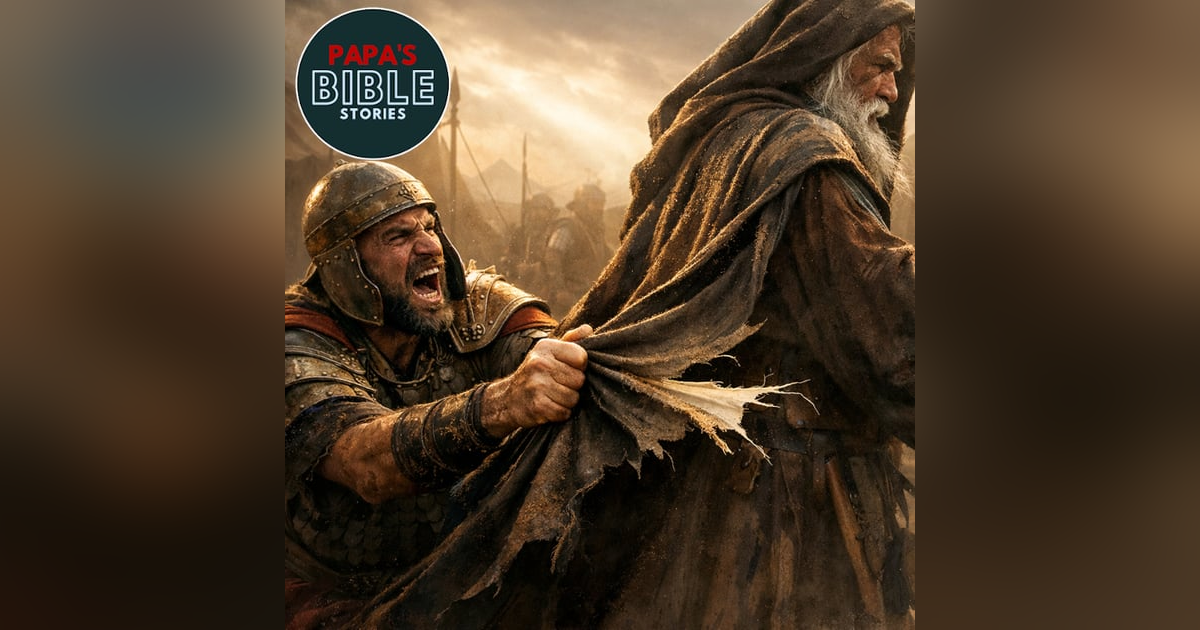
But strangely, Saul didn’t seem to be as upset about God’s judgement as he was about Samuel leaving. It seems that there was some kind of ceremony that was about to happen that Samuel was supposed to be a part of. And if Samuel wasn’t at that ceremony, the people would know that Samuel didn’t support Saul anymore. And since Samuel was still very popular among the Israelites…even more popular than Saul…if Samuel walked away from him now…that might be the end of Saul’s kingship right then and there. And Saul just couldn’t have that. So, Saul continued and said, “Now therefore, please pardon my sin, and return with me, that I may worship the Lord.” (15:25) And at first Samuel refused, and said, “I will not return with you, for you have rejected the word of the Lord, and the Lord has rejected you from being king over Israel.” (15:26) I mean, why would he go with Saul when God had rejected him? And Samuel turned around to go again. But Saul was desperate. And he grabbed the edge of Samuel’s robe and, in the heat of the moment, ended up tearing it. Samuel looked down at his torn robe, and to drive the point home even more, Samuel said to Saul, “The Lord has torn the kingdom of Israel from you today, and has given it to a neighbor of yours, who is better than you. And also the Strength of Israel will not lie or relent. For He is not a man, that He should relent.” (15:28-29) God would not change His mind. In fact, God already had someone else in mind for king.
But all Saul seemed to care about was what was happening right at that moment…that there was this ceremony and that Samuel needed to go. And he said to Samuel, “I have sinned; yet honour me now, please, before the elders of my people and before Israel, and return with me, that I may worship the Lord your God.” (15:30) Saul was absolutely adamant that Samuel came with him. And after thinking about it for a second, Samuel changed his mind and decided to go with Saul. I mean, it’s not like anyone wanted the Israelite government to fall apart right then and there. And while God already had a new king in mind, Samuel knew that that it would take some time. And besides, there was one other thing that Samuel needed to do while he was there. And so, Samuel went with Saul, and in the presence of the elders and all the people, they worshipped together. But then, in the middle of the ceremony, right when all the Israelites were watching, Samuel decided it was time to take care of that one other thing. And Samuel said, “Bring Agag king of the Amalekites here to me.” (15:32) And it was done. And, grabbing a sword, Samuel said to King Agag, “As your sword has made women childless, so shall your mother be childless among women.” (15:33) And right then and there, right during the worship service, Samuel killed the king of the Amalekites. At least this way, the surrounding nations might get at least part of the idea that this wasn’t a normal campaign. And with that, Samuel left.
After everything was over, Samuel and Saul parted ways - Samuel headed back home to Ramah and Saul headed back home to Gibeah. The two would never talk again. Samuel would continue to mourn for Saul. And Saul, well, he was never quite the same after this. Now that Saul knew his days as king were numbered, he started looking over his shoulder…always wondering which one of his “neighbors” would be the new king. And so Saul, who had started off as an excellent king, a king who had seen so many victories over Israel’s enemies, a king who had every advantage and blessing…wound up becoming paranoid, scared, and obsessive. And as Saul’s kingship slowly descended into failure, he would have been tempted to look back at his life and realize that…when he’d been at his best…when times were good…was back at the very beginning…when Saul was king but was also still just a farmer. Those were the days when Saul had no idea what he was doing…but he also had no image to worry about…no pride. It was when he had to depend on God for everything. Those were the good old days. And you know, kidzos, Saul’s story isn’t so different from ours. We’re at our very best too—not when we feel big or important—but when we’re humble enough to depend on God…for everything.


